

AI is changing every businesses’ relationship with their market. Google just announced how they’re adapting and what it might mean for your business.
Google Marketing Live 2026 Key Points:
- User inputs have changed. (Longer, detailed, looking for specific solution.)
- Paid search, organic search, creative, and analytics will be one AI-driven ecosystem where each part feeds the other.
- To date, AI support in Google Ads has been optional. Soon it will be the only way to use the platform.
- Search is shifting from “results” to “answers.” Keywords are no longer the driver. Google’s AI will decide if it understands and trusts your brand enough to include it in the user’s decision process.
- “Zero click search” is here. Multiple sources show that AI summaries and overviews cut search clickthrough rates by 50% or more.
- B2B marketing fundamentals will matter more, not less. Strong positioning, credible content, industry clout, clean data, CRM integration, and clear measurement will determine if AI is helping you scale or leaving you behind.
- Marketers need to use Google’s AI, but not surrender judgement to it. Google will increasingly use AI to shape targeting, creative, attribution, and predictive performance. Independent measurement, business-level KPIs, and human strategic oversight will be more important than ever.
Goodbye Sales Funnel, Hello Decision Web
Google Marketing Live 2026 was not just another advertising product launch. To us at ruef Creative, it was a clear statement about where Google believes marketing is headed: away from channel-by-channel execution and toward an AI-mediated ecosystem where search behavior, paid media, creative, commerce, and analytics are increasingly connected through one operating layer.
That matters for every marketer. It matters especially for B2B companies, where buyers do not move neatly from impression to click to form fill. They research, compare, validate, disappear, return, ask technical questions, involve multiple stakeholders, and often convert long after the first signal of intent. It’s a web of decision making actions that is far from a linear “sales funnel.”
Our biggest takeaway? Robust content strategies, active industry engagement, and tight brand management are more important than ever. Google is reorganizing the marketing workflow around AI systems that interpret demand, generate and place messages, shape the search experience, and increasingly explain performance back to the advertiser.
Google Is Collapsing the Distance Between Search, Ads, and Answers
For years, Google Search worked on a relatively familiar exchange. A user searched. Google returned links. Ads appeared around those links. Marketers optimized for visibility, relevance, and conversion. All pinned together by keywords.
With AI Overviews, AI Mode, conversational discovery, and new sponsored answer formats, Google is moving from a search results page toward an answer environment. The search box is becoming less of a keyword-matching utility and more of a conversational interface. The ad is becoming less of a discrete unit on the page and more of a possible part of the answer itself.
For B2B marketers, this is a major philosophical shift. The old search model rewarded being the best match for a query. The new model rewards being a trusted input into Google’s AI interpretation of the buyer’s problem. That means organic content, paid media, landing pages, product data, brand signals, and conversion data all begin to matter together.
A technical buyer may not search “industrial air compressor service provider Ohio” in the old way. They may ask a much longer question about maintenance intervals, replacement cost, compliance requirements, or downtime risk. Google’s AI layer will try to interpret the problem, summarize the options, and decide what content or advertisers belong in that moment.
That changes what visibility means. It is no longer only about ranking, bidding, or writing strong ad copy. It is about whether Google’s ecosystem understands who you are, what you offer, when you are relevant, and why you should be trusted.
Paid Search Is Becoming Less Manual and More Interpretive
The direction of paid search is clear: Google wants advertisers to rely less on manual control and more on AI-led interpretation. AI Max for Search is the most obvious signal. Keywords are not disappearing overnight, but they are becoming less central as direct controls. Google is pushing advertisers toward broader matching, automated asset generation, dynamic routing, and AI-assisted campaign structures that decide where ads should appear based on intent rather than exact query mechanics.
There is a credible upside here. B2B buyers often search in fragmented, inconsistent, highly specific ways. They use technical language, informal language, product shorthand, competitor comparisons, problem statements, and long-tail questions. A well-trained AI system can potentially find demand that a conventional keyword list would miss.
But the trade-off is equally real. B2B marketing depends on precision. A small difference in application, specification, buyer role, service territory, or industry context can completely change lead quality. For technical, industrial, regulated, or complex-sale categories, “close enough” is often not good enough.
So, the strategic issue is not whether AI-led paid search is good or bad. It is that paid search is becoming a judgment system. Google is asking advertisers to trust its AI to understand the buyer, choose the message, select the surface, route the click, and eventually value the outcome.
That makes the marketer’s role less about managing every lever and more about shaping the system: feeding it better data, giving it better content, defining clearer business outcomes, and knowing when the machine’s interpretation does not match the commercial reality.
Organic Search Is Being Pulled into the Same AI System
The paid search story cannot be separated from organic search. AI Overviews and AI Mode point toward a future where Google answers more questions directly, summarizes more of the web, and reduces the number of moments where a user needs to click through to a site. Ahrefs found a 58% drop in clickthrough rate for the top-ranking link in search results! (https://ahrefs.com/blog/ai-overviews-reduce-clicks-update/)
For B2B companies, the risk is concentrated in the kind of content that historically performed well in organic search: definitions, explainers, comparison posts, “what is” content, and high-level educational resources. If that content is generic, Google’s AI can summarize it easily. If the answer is resolved on the search page, the website visit may never happen.
But this does not mean SEO is dead. It means the job of SEO is changing. Google still needs sources. AI-generated answers still draw from the web, from structured information, from brand authority, from product details, from expert content, and from signals of credibility. The difference is that the value shifts from earning the click on every informational query to becoming a source that AI systems trust, cite, summarize, and associate with a category.
For ruef’s clients, that puts a premium on substance. Thin content becomes less defensible. Original experience becomes more valuable. Application notes, technical guides, customer outcomes, proprietary data, expert commentary, product knowledge bases, implementation details, and industry-specific analysis become more important because they provide something AI cannot easily synthesize from common web copy.
The broad direction is clear: organic search and paid search are converging around the same underlying question. Does Google understand your brand well enough to place it inside the buyer’s decision process?
Analytics Is Becoming the Connective Tissue
The most strategically important part of Google Marketing Live may not have been a search feature at all. It may have been measurement.
Google’s expanded analytics and measurement announcements point toward a system where marketing performance is not just reported after the fact. It is modeled, predicted, and fed back into campaign optimization. Meridian in Google Analytics 360, Qualified Future Conversions, Attributed Branded Searches, Campaign Type Attribution, journey-aware bidding, and lead-stage measurement all reflect the same idea: Google wants analytics to become an active part of the media engine.
Most B2B marketing measurement has always been incomplete. The real outcome is not the click. It is not even the lead. It is qualified pipeline, opportunity creation, sales velocity, deal quality, and revenue. Those outcomes happen late, often outside the ad platform, and often after multiple touches across search, YouTube, LinkedIn, organic, direct traffic, email, events, referrals, and sales outreach. Google is trying to close that gap by giving advertisers more ways to connect early signals to later business outcomes. That is directionally useful. It also deepens Google’s influence over how performance is interpreted.
If Google is serving the ad, shaping the AI answer, generating the creative, modeling the future conversion, and providing the analytics interface, then marketers need to be thoughtful about governance. The platform’s view of performance may be valuable, but it cannot be the only view.
For ruef, this is where the ecosystem story becomes most important. Paid search, organic search, YouTube, creative, website content, CRM data, and analytics are no longer separate workstreams. They are becoming interdependent inputs into an AI-driven marketing loop, and the quality of that loop depends on the quality of the signals.
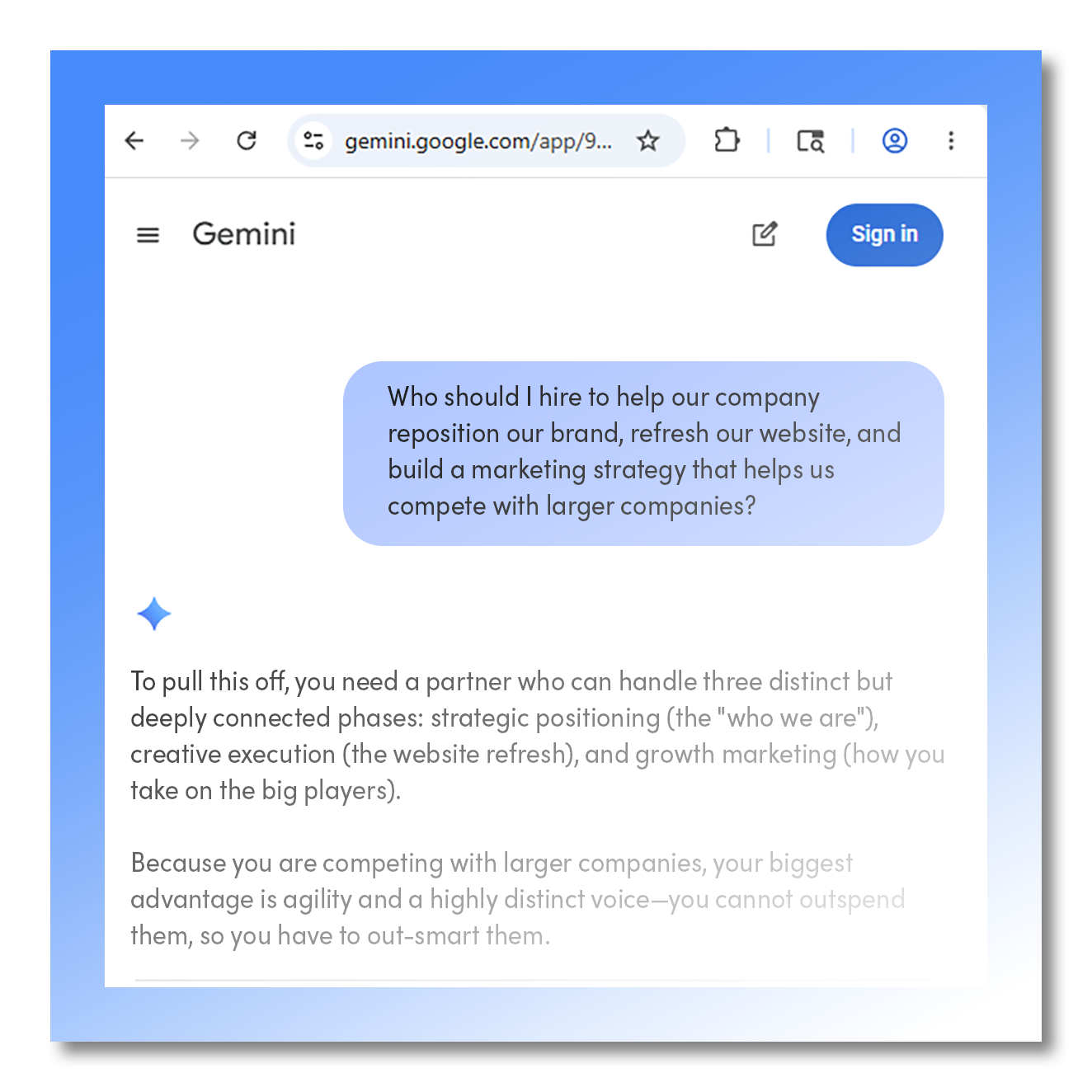
Google Marketing Live 2026 – Screenshot of a Google Gemini session. The user asks about who to hire for marketing and Gemini gives its response.
The Website Is No Longer Just a Destination
One of the more subtle implications of Google’s direction is that the website is becoming more than a post-click destination. It is becoming source material for AI systems.
Landing pages, product pages, service pages, FAQs, case studies, schema, feeds, and technical documentation all shape what Google can understand about a business. In the past, a weak page
might hurt conversion rate or organic ranking. In the new environment, weak content can also weaken ad relevance, AI-generated messaging, lead qualification, and measurement quality.
This is a major shift for B2B organizations whose websites are often underdeveloped relative to the complexity of their offerings. A company may have deep technical expertise, strong salespeople, excellent customer relationships, and differentiated capabilities. But if that knowledge is not expressed clearly online, AI systems may not know how to represent it. Worse, they may represent it incompletely.
That is why ruef sees content, SEO, paid media, and analytics increasingly merging into one strategic discipline. The website is not just where campaigns send traffic. It is the knowledge base that helps the ecosystem understand the business.
Creative Is Becoming Modular, but Strategy Matters More
Google’s creative announcements also fit the broader pattern. Asset Studio, AI-generated variants, multimodal tools, and automated testing all point toward a world where creative production is faster and more modular.
For B2B marketers, this is less about flooding the market with AI-generated assets and more about increasing the speed of learning. Complex B2B campaigns often require different messages for different industries, buying committees, pain points, technical needs, and decision stages. Historically, production constraints limited how much could be tested. AI helps reduce that friction.
But faster production does not automatically create better marketing. If the strategy is weak, AI simply produces more weak variations. If the positioning is unclear, the outputs will be unclear. If the proof points are generic, the creative will be generic. If the brand has not defined what it believes, what it refuses to say, and what evidence supports its claims, automation can create noise at scale.
This is another place where the marketer’s role shifts upstream. The value is not in manually producing every asset. The value is in defining the strategic boundaries that allow automated creative systems to produce useful work.
The Opportunity for B2B Is Real, but Uneven
Google’s ecosystem direction creates meaningful opportunities for B2B marketers. It can help surface demand that is hard to capture through traditional keywords. It can make early touch channels like YouTube and Demand Gen easier to evaluate. It can connect lead-stage data back into optimization. It can make creative testing faster. It can turn static lead forms into more conversational experiences. It can help marketers understand long-cycle performance with more nuance than last-click reporting ever allowed.
However, the benefits will not be distributed evenly. Companies with strong content, clean data, disciplined analytics, clear positioning, and well-defined sales stages will get more from Google’s AI systems. Companies with vague messaging, disconnected CRM data, thin websites, inconsistent tracking, and unclear definitions of lead quality may see automation amplify their weaknesses.
That is the central ruef takeaway: AI does not remove the need for marketing fundamentals. It raises the cost of neglecting them.
What This Means for Ruef and Ruef’s Clients
For ruef, Google Marketing Live 2026 reinforces a view we already hold: modern B2B marketing cannot be managed as a set of disconnected channels.
Paid search is not separate from SEO. SEO is not separate from content strategy. Content strategy is not separate from analytics. Analytics is not separate from CRM hygiene. Creative is not separate from measurement. The website is not separate from the media plan. Google is building toward an ecosystem where all those pieces inform one another. That creates a more powerful system, but also a more complex one.
The work ahead for B2B marketers is less about chasing every new product announcement and more about becoming understandable and credible to AI systems while remaining accountable to business outcomes. Brands need to make their expertise clear, their data usable, their content credible, their measurement connected, and their strategy explicit.
That is especially true for industrial, technical, professional services, and complex-sale companies. These businesses often have rich expertise but poor digital translation. Google’s AI shift will reward the companies that can translate what they know into structured, trustworthy, buyer-relevant digital signals.
The Bottom Line
Google Marketing Live 2026 confirmed that Google is not simply adding AI features to marketing tools. It is turning its marketing tools into an AI ecosystem. Search is becoming more conversational. Paid search is becoming more interpretive. Organic visibility is becoming more dependent on authority and source quality. Creative is becoming more modular. Analytics is becoming more predictive. And the boundaries between all these disciplines are getting thinner.
For B2B marketers, the response should not be panic, and it should not be blind adoption. The right response is strategic clarity. Google is asking marketers to trust more of the system to AI. The brands that win will be the ones that give that system better inputs while keeping human judgment firmly attached to the business outcome.
At ruef, we see this as the next phase of B2B marketing: not search versus paid search, not media versus analytics, not content versus conversion, but one connected ecosystem where strategy, data, content, and measurement determine how well AI can represent a brand in the market.